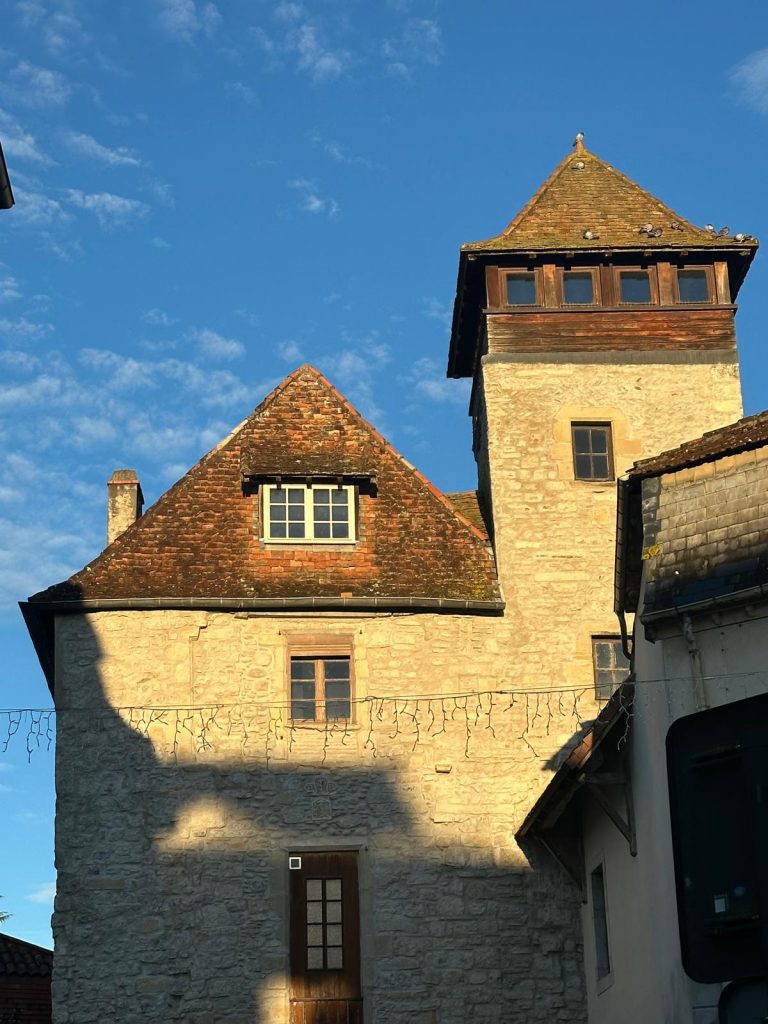
The Guard House (formerly A Boste) is a thousand-year-old castle adapted as a residence for artists and creative workshops in southwest France near Spain. It is located in the spectacular medieval village of Sauveterre-de-Béarn, on the Camino de Santiago de Compostela, offering both the presence of village life and a genuine retreat from the outside world.
Surrounded by open countryside, the site provides direct access to rural walks, a nearby river suitable for wild swimming, and wide, uninterrupted views toward the Pyrenees mountain range, which forms the southern horizon. The changing skies and long vistas create a sense of space and distance that supports focus, reflection, and sustained creative work. The village itself offers all facilities needed for daily life, including shops, restaurants, and medical services. Local train and bus connections, as well as several nearby airports, make the area easily accessible.
The property was acquired by Magdalena Groszek, who continues to restore and develop the site through personal investment and with the support of BéArtz, a local non-profit arts association. Today, the castle serves as the headquarters of BéArtz and is used exclusively for artist residencies, workshops, exhibitions, and cultural events.
The project is conceived as a safe, incubatory environment—a place where artists can slow down, explore ideas, take risks, and play without pressure for immediate outcomes. Emphasis is placed on trust, continuity, and the freedom to experiment, allowing work to develop organically. Many artists return regularly, sometimes year after year, forming lasting connections with both the place and the project.
Each room has a distinct, artistic character, combining original artworks with a high level of comfort. The building includes eight bedrooms and four art studios of varying sizes. A large communal kitchen forms a central working space, with extensive shared work surfaces, a wide range of cooking equipment, and original artworks throughout. It is designed for collective use and regularly supports shared meals and occasional pop-up food events.
The region enjoys a mild Atlantic-influenced microclimate. Despite the proximity of the Pyrenees mountains, winters are generally gentle, allowing citrus trees, kiwis, avocados, pomegranates, and palm trees to grow in the area—an indication of conditions well suited to year-round creative activity.
BéArtz supports both local and visiting artists and works closely with the surrounding community through artist residencies and on-site workshops. Creative practice is approached holistically, valuing being as much as doing. Alongside visual arts, the space welcomes embodied practices such as movement, dance, yoga and music. Food is considered an important part of daily life:Meals are often shared, using fresh, local ingredients, either on site or in the village during workshops
The castle also includes a small music studio and an imperial grand Bösendorfer piano, used for rehearsals and occasional concerts. In addition to the castle, BéArtz is developing a nearby studio space with encaustic painting and printing facilities.